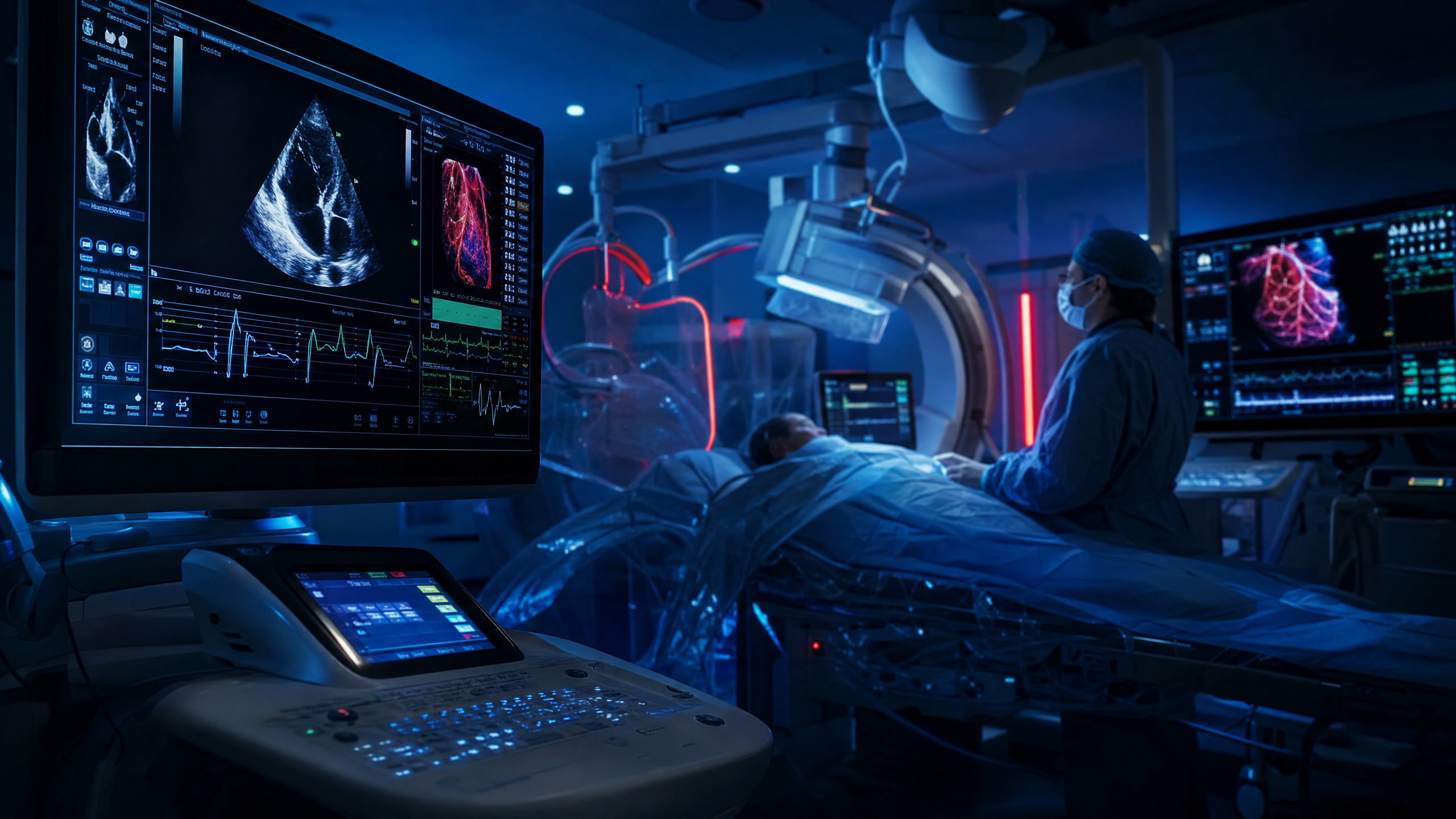
Cardiac Exams & Testing
A complete guide to cardiac diagnostics — from simple EKGs to advanced imaging and surgical procedures — for patients and clinicians alike.
About accuracy figures: Sensitivity and specificity values are approximate ranges drawn from published clinical literature and may vary based on patient population, operator skill, and specific indication. Non-invasive and imaging tests are ordered by overall diagnostic accuracy for coronary artery disease (CAD) detection.
Section 1 · Ranked Least → Most Accurate
Non-Invasive Tests
These tests require no needles, incisions, or radiation. They are typically the first step in evaluating heart health.
EKG (Electrocardiogram)
Duration
5–10 minutes
Accuracy
~50–60%for CAD detection
Records the electrical activity of the heart using electrodes placed on the skin. Excellent for detecting arrhythmias and acute MI, but limited in evaluating blood flow or structural disease.
Holter Monitor
Duration
24–48 hours
Accuracy
~60–70%for arrhythmia capture
Continuous ECG monitoring worn for 24–48 hours to detect intermittent arrhythmias and correlate symptoms with cardiac rhythm. Limited to electrical activity only.
Stress Test (Exercise Treadmill)
Duration
45–60 minutes
Accuracy
~68–75%sensitivity/specificity for CAD
Evaluates how the heart responds to physical exertion using EKG changes. Useful for CAD screening but has significant false-positive and false-negative rates, especially in women.
Section 2 · Ranked Most → Least Accurate
Cardiac Imaging
Advanced imaging tests that create detailed pictures of the heart's structure, function, and blood flow.
Accuracy Summary — All Cardiac Imaging Tests
| Rank | Test | Accuracy Range | Duration | Radiation | What It Looks At | Blockage Detection | Best For |
|---|---|---|---|---|---|---|---|
| #1 | Cardiac PET/CT ★ | ~90–95% | 30–60 min | Blood flow + structure | Low | ★★★★★Excellent Detects flow-limiting blockages + microvascular disease | Absolute MBF, microvascular CAD |
| #2 | Coronary CTA | ~85–95% | 15–30 min | Structure only | Low | ★★★★★Very Good Sees artery anatomy & plaque; can’t confirm if blockage restricts flow | Ruling out CAD, plaque anatomy |
| #3 | Cardiac MRI (CMR) | ~85–92% | 45–75 min | Structure + scar tissue | None | ★★★★★Good Detects downstream effects of blockages (scar, wall motion); not artery anatomy | Cardiomyopathy, myocarditis, scar |
| #4 | Nuclear SPECT | ~73–82% | 2–3 hrs | Blood flow (limited) | Moderate | ★★★★★Good Detects major blockages; misses microvascular disease & balanced ischemia | Perfusion, risk stratification |
| #5 | Echocardiogram | ~75–85% | 30–60 min | Structure + movement | None | ★★★★★Limited Cannot see coronary arteries; only detects wall motion abnormalities caused by blockages | Valves, wall motion, EF |
★ Class I Recommendation — ASNC 2026 · Accuracy ranges are approximate and drawn from published meta-analyses. Individual results may vary by patient population, operator skill, and indication.
Echocardiogram
Duration
30–60 minutes
Accuracy
~75–85%for structural/functional assessment
Uses ultrasound waves to create real-time images of the heart's structure and function. Excellent for valve disease and wall motion, but image quality can be limited by body habitus.
✓ Sees Well
- •Heart valve structure and function — whether valves open and close properly (stenosis or leakage)
- •How well the heart muscle squeezes — measures ejection fraction (EF), the percentage of blood pumped out each beat
- •Chamber size and wall thickness — detects an enlarged or thickened heart
- •Fluid around the heart (pericardial effusion) — can be life-threatening if not caught
- •Blood clots sitting inside the heart chambers
- •Wall motion during stress — areas that stop moving under stress may indicate blocked arteries
✗ Does Not See
- •Coronary arteries directly — it cannot see blockages or plaque inside the arteries at all
- •Blood flow to the heart muscle — it shows how the wall moves, not how much blood is actually reaching it
- •Scar tissue or fibrosis inside the heart muscle — MRI is far better for this
- •Patients with obesity or lung disease often get poor image quality due to sound wave interference
Coronary CTA (CT Angiography)
Duration
15–30 minutes
Accuracy
~85–95%sensitivity for significant CAD
Non-invasive imaging of the coronary arteries using computed tomography. Excellent negative predictive value for ruling out CAD, with high sensitivity for detecting coronary stenosis.
✓ Sees Well
- •The structure and anatomy of the coronary arteries — it creates a detailed 3D picture of the artery walls
- •Hard (calcified) plaque — calcium deposits inside artery walls show up very clearly as bright white spots
- •Soft (non-calcified) plaque — CTA can detect it, but it is harder to measure accurately than hard plaque
- •How narrow an artery has become (stenosis) — useful for identifying significant blockages
- •Coronary calcium score — a separate quick scan that counts calcium deposits as a long-term heart attack risk predictor
- •Ruling out heart disease — a normal CTA is very reliable for saying the arteries are clean
✗ Does Not See
- •Whether a blockage is actually reducing blood flow — CTA shows the anatomy but cannot measure if blood is getting through adequately; a 70% narrowing on CTA may or may not be causing a problem
- •Blood flow to the heart muscle — it sees the pipes, not the flow inside them; PET/CT or SPECT are needed for that
- •Heavily calcified arteries — when arteries are full of calcium, the bright white 'bloom' obscures the lumen and makes the image unreadable
- •Soft plaque vulnerability — it can see soft plaque exists but cannot reliably tell if it is about to rupture (unstable)
- •Heart muscle function, valve disease, or scar tissue
Cardiac MRI (CMR)
Duration
45–75 minutes
Accuracy
~85–92%for myocardial viability & cardiomyopathy
Cardiac Magnetic Resonance Imaging uses powerful magnetic fields and radio waves — no radiation — to produce highly detailed images of the heart's structure, tissue, and function. It is considered the gold standard for evaluating cardiomyopathies, myocarditis, and myocardial viability, though it is less widely used for routine CAD perfusion imaging.
✓ Sees Well
- •Scar tissue and fibrosis inside the heart muscle — using a contrast agent (gadolinium), MRI can precisely map dead or damaged tissue that no other test can show as clearly
- •Cardiomyopathy — it can identify the type (thickened, dilated, or inflamed heart muscle) and how severe it is
- •Myocarditis (inflammation of the heart muscle) — often caused by viruses; MRI is the only non-invasive test that can confirm it
- •Heart muscle function and ejection fraction with the highest precision of any imaging test
- •Congenital heart defects — excellent for complex structural abnormalities present from birth
- •Stress perfusion — with a special protocol, MRI can show areas of reduced blood flow during stress
✗ Does Not See
- •Coronary artery blockages — MRI is not used to directly image the coronary arteries in routine practice; CTA or catheterization is used for that
- •Absolute blood flow numbers — unlike PET/CT, standard cardiac MRI cannot measure the exact milliliters of blood reaching the muscle per minute
- •Patients with older pacemakers or certain metal implants — the strong magnetic field is incompatible with some devices (though newer MRI-safe devices exist)
- •Claustrophobic patients may struggle — the scan takes 45–75 minutes inside a narrow tube
Nuclear SPECT
Duration
2–3 hours
Accuracy
~73–82%sensitivity/specificity for CAD
Uses radioactive tracers (Tc-99m) to evaluate myocardial perfusion at rest and stress. Well-established modality with decades of clinical data, though limited by attenuation artifacts.
✓ Sees Well
- •Blood flow to the heart muscle — shows which areas of the heart are getting enough blood at rest and during stress (a treadmill or medication-induced stress)
- •Areas of ischemia — regions where blood supply is reduced due to a blocked artery show up as 'cold spots' on the scan
- •Myocardial viability — can distinguish between heart muscle that is damaged but still alive (hibernating, can recover after a stent) versus permanently scarred tissue
- •Risk of future heart attacks — the size and location of perfusion defects helps predict long-term cardiac risk
✗ Does Not See
- •Absolute blood flow — SPECT only shows relative differences between regions (one area looks worse than another), not the actual milliliters of blood per minute; this means diffuse disease affecting the whole heart equally can be missed entirely
- •Microvascular disease — when the tiny blood vessels (not the main arteries) are diseased, SPECT often appears normal even though the patient has significant heart disease; this is a major limitation, especially in women and diabetics
- •Coronary artery anatomy or plaque — it sees blood flow, not the arteries themselves
- •Attenuation artifacts — the body itself (breast tissue in women, the diaphragm) can block the radiation signal and create false 'defects' that look like disease but are not
Cardiac PET/CT
Duration
30–60 minutes
Accuracy
~90–95%highest of all non-invasive tests
The gold standard for myocardial perfusion imaging. Uses short-lived positron-emitting tracers (Rb-82, N-13) with absolute quantification of myocardial blood flow. In January 2026, ASNC issued a Class I recommendation making PET/CT the preferred first-line imaging test for all patients with suspected CAD.
✓ Sees Well
- •Absolute blood flow — PET/CT is the only non-invasive test that measures the exact amount of blood reaching each part of the heart muscle (in mL/min/g). This is its biggest advantage over every other test
- •Microvascular disease — when the tiny blood vessels are diseased (common in women, diabetics, and patients with chest pain but 'normal' arteries), PET/CT detects it; SPECT almost always misses it
- •Diffuse coronary artery disease — when all arteries are equally diseased, relative tests like SPECT appear normal; PET/CT catches this because it measures absolute flow, not just comparisons
- •Ischemia and infarct with the highest accuracy of any non-invasive test — fewer false positives and false negatives than SPECT
- •Obese patients and women — PET/CT is far less affected by body size and breast tissue than SPECT, making it more reliable in these groups
- •Myocardial viability — identifies heart muscle that is alive but not functioning (can recover after bypass surgery or a stent)
✗ Does Not See
- •Coronary artery anatomy or plaque — PET/CT shows blood flow to the muscle, not the structure of the arteries themselves; CTA or catheterization is needed to see the arteries directly
- •Valve structure or function — echocardiogram is far better for this
- •Scar tissue detail inside the heart muscle — MRI with gadolinium contrast is the gold standard for mapping fibrosis
Section 3 · Interventional & Surgical
Invasive Procedures
These procedures involve entering the body and are typically performed when non-invasive tests indicate significant heart disease requiring treatment.
Important: Invasive procedures carry risks including bleeding, infection, and rare but serious complications. All decisions should be made in close consultation with a board-certified cardiologist or cardiac surgeon.
Cardiac Catheterization
Duration
1–2 hours
Recovery
4–6 hours (same-day)
A thin flexible tube (catheter) is inserted through an artery in the wrist or groin and guided to the heart. Dye is injected to visualize coronary arteries on X-ray (angiography). Considered the gold standard for diagnosing coronary artery disease and can be combined with stent placement (PCI) during the same procedure.
What to Expect
You will be awake but sedated. A small incision is made at the wrist or groin. Most patients go home the same day.
Coronary Artery Bypass Surgery (CABG)
Duration
3–6 hours
Recovery
6–12 weeks
Open-heart surgery in which a healthy blood vessel (from the leg, arm, or chest wall) is grafted to bypass a blocked coronary artery, restoring blood flow to the heart muscle. Recommended for patients with multiple severe blockages or left main coronary artery disease where stenting is not sufficient.
What to Expect
Performed under general anesthesia. Requires a hospital stay of 5–7 days. Full recovery takes 6–12 weeks. Cardiac rehabilitation is strongly recommended.
Pacemaker Implantation
Duration
1–2 hours
Recovery
1–2 days hospital, 4–6 weeks full
A small electronic device is implanted under the skin near the collarbone to regulate abnormal heart rhythms. Leads (wires) are threaded through a vein into the heart chambers. Modern pacemakers are MRI-compatible and can last 10–15 years. Some devices also function as defibrillators (ICD) to treat life-threatening arrhythmias.
What to Expect
Performed under local anesthesia with sedation. A small pocket is created under the skin. Most patients go home the next day and resume normal activity within 4–6 weeks.
Stay Current on Diagnostic Advances
Read the latest research on cardiac imaging and diagnostic innovations in our News section.
Read Latest News